
Home renovation trends across Canada vary significantly between urban and rural areas. Shifting economic factors, housing density, and evolving lifestyle priorities have created distinct patterns in how Canadians approach home improvement today. This blog delves into the key differences between urban and rural renovation activities while analyzing recent shifts in homeowner spending and project choices using micro-geographic consumer behavioral modeling from Manifold Data Mining.
Urban Renovation Trends: The Case of Toronto
Toronto, Canada’s largest urban center, has shown a noticeable decline in several types of home renovations over the past two years:
- Pool/Spa Installations: 55% less likely than the Canadian average.
- Deck/Fencing Additions: 30% less likely.
- Exterior Painting/Staining: 45% less likely.
These trends may be attributed to the high density of apartment living in Toronto, where homeowners have limited access to outdoor space, reducing the need for such renovations. Additionally, the urban lifestyle in Toronto, with its emphasis on convenience and proximity to amenities, may deprioritize large-scale exterior projects. Interestingly, the Greater Toronto Area stands out in kitchen and basement renovations, which are 15% more likely than the national average.
2025-2026 Trend Spotlight: High Values, Smaller Scope
Recent Polaris Intelligence data highlights this urban shift: while Toronto home values average $1.28M (71% above the $749k national benchmark), complete teardowns and major rebuilds have slowed dramatically (Index of 62 vs. 100 national average). Instead, 95% of Toronto homes require only minor maintenance or repairs. However, because of higher labor and material costs, Toronto households spend an average of $1,632 annually on renovations—24% higher than the national average ($1,315)—focusing their budgets on high-impact interior refinements rather than full structural overhauls.
Rural Renovation Trends: The Bruce Peninsula Example
In contrast, the Bruce Peninsula, a rural area known for its natural beauty and larger properties, exhibits a different pattern:
- Living Space Additions, Decks/Fencing, and Flooring: 40% more likely than the national average.
- Energy Conservation Products: 30% more likely, reflecting a strong focus on sustainability.
- Landscaping and Interior Renovations (Kitchens, Interior painting and wallpaper): 30% higher than average.
However, some areas see lower activity, such as basement renovations (35% less likely) and home security systems (10% less likely). These trends suggest that rural homeowners prioritize outdoor living and sustainability while potentially underestimating the need for security upgrades due to the lower crime rates in rural areas.
Rural Canadians in the Bruce Peninsula spend about 15% more on home renovations than the national average. This higher expenditure could be linked to the larger property sizes, the desire for self-sufficiency, and the importance placed on enhancing the aesthetic and functional aspects of their homes.
Post-COVID Renovation Trends: From Pandemic Boom to Today’s Market
The pandemic years triggered an unprecedented home renovation boom across Canada. With households spending extended time indoors, demand skyrocketed for immediate comfort, dedicated remote workspaces, energy efficiency, and outdoor living upgrades. Today, however, the market has moved beyond that initial surge, shaped by broader economic factors, higher interest rates, and evolving consumer habits.
Decline in Energy Efficiency Upgrades:
Our data shows a sharp decline in energy conservation renovation projects following peak pandemic years. After holding steady around 1.75M to 1.8M projects annually between 2017 and 2020, activity dropped significantly to approximately 1.4M by 2023, reflecting energy price stabilization, shifting household spending, and reduced rebate incentives.
- Stabilization of Energy Prices: During the pandemic, concerns about rising energy costs drove homeowners to invest in energy-efficient upgrades. As energy prices stabilized post-pandemic, the urgency to make these investments waned.
- Shift in Priorities: While pandemic-era spending centered heavily on home containment and efficiency, discretionary household budgets are now more evenly distributed toward travel, entertainment, and lifestyle experiences.
- Economic Uncertainty and Inflation: Rising living expenses and economic uncertainties have made homeowners more cautious about discretionary spending, leading many to delay or forgo costly energy efficiency projects.
- Reduced Government Incentives: The expiration of government rebates for energy efficiency improvements has decreased the financial motivation for such upgrades.
- Hybrid Work Models: With fewer people working from home full-time, the need to optimize home energy consumption has diminished.
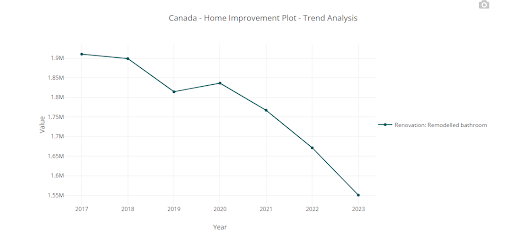
Decreasing Bathroom Renovations:
- Bathroom renovations, which spiked alongside general interior work during the pandemic, have seen a consistent decline since 2020. Today, homeowners facing tighter budgets are prioritizing high-impact, multi-use areas like kitchens and primary living spaces over smaller, cosmetic bathroom updates. Economic uncertainty and inflation may also contribute, as homeowners become more cautious with spending on non-essential renovations.
These factors collectively contributed to a slowdown in energy efficiency upgrades and bathroom renovations, which had gained momentum during the pandemic. Homeowners are now redirecting their focus to other areas that align with their evolving lifestyles and priorities and have reduced spending on home renovations and improvements overall.
Key Takeaways
- Urban vs. Rural Differences: Urban areas like Toronto prioritize interior renovations that optimize space, while rural areas like the Bruce Peninsula focus on outdoor improvements and sustainability.
- Spending Trends: Rural Canadians are willing to invest more in home improvements, possibly due to larger properties and a greater emphasis on self-sufficiency.
- Evolving Priorities: Energy efficiency upgrades and bathroom renovations have seen a decline relative to peak years as inflation and broader economic factors prompt homeowners to re-evaluate discretionary renovation spending.
Conclusion
Understanding the nuanced differences in home renovation trends between urban and rural areas, and the factors driving post-COVID shifts, can provide valuable insights for industries involved in home improvement, real estate, and energy efficiency. For businesses, especially those in the renovation and home improvement sectors, tailoring strategies to the specific needs of these segments can enhance customer engagement and drive growth.
The data highlights the importance of recognizing both the initial pandemic boom and the economic realities shaping today’s housing market. As homeowner priorities normalize, understanding these shifting behaviors is essential for predicting where Canadian renovation dollars will flow next.