
Introduction
Canada’s population growth has become one of the most significant demographic stories of the past decade. While Canada’s population growth has historically been driven by a combination of births and immigration, the nation’s demographic landscape is shifting rapidly.
Today, Canada’s population is aging at an accelerated rate. In many parts of the country, the number of deaths exceeds the number of births, causing a natural population decline. Consequently, immigration has now become the primary driver of population growth within our country.
According to Polaris data, Canada’s population grew by 3.19% between 2024 and 2025. Population growth often supports economic expansion and labour force growth. However, excessive growth can place significant pressure on housing, infrastructure, health care, and public services. A sustainable growth rate over time is considered to be between 0.5%-1.5%. Within this growth rate, while capitalizing on the advantages, the country is still able to maintain service levels and quality of life.
However, different regions of Canada are growing at vastly uneven paces. Nowhere is this shifting dynamic more obvious than Alberta, which currently leads the nation’s population growth.
Canada’s overall population growth rate: 3.19%
Alberta’s population growth rate: 3.49%
Why Is Alberta Attracting So Many New Residents?
Alberta has remained Canada’s fastest growing province by a significant margin over the last several years. Alberta’s population boom is driven by a combination of the following demographic factors:
- Interprovincial Migration: The majority of these internal migrants are moving from Ontario and British Columbia to Alberta for a lower cost of living, a more affordable housing market, and stronger job prospects. Additionally, there are overall lower tax burdens, and Alberta continues to invest in its economic development and infrastructure.
- International Immigration: Alberta has welcomed a vast number of permanent residents, and non-permanent residents, such as temporary workers and international students, into the province.
- The “Demographic Dividend”: Those moving to Alberta tend to be younger adults, who are in their prime working and family-planning years. In Alberta, individuals between the ages of 25-44 account for 30.49% of the total population, compared to Canada’s 28.7%, which has led to a strong natural increase. By contrast, some areas, especially located in Atlantic Canada and Quebec, have been facing a natural decline (more deaths than births).
According to Polaris Intelligence, Alberta’s population has increased by 3.49% between 2024 and 2025. Calgary and Edmonton account for the majority of this growth, but many smaller municipalities have been experiencing groundbreaking rates of expansion.
The Alberta Town Everyone is Moving to (And No, It’s not Calgary)
There’s growing, and there’s whatever’s happening in Chestermere. Imagine a place with stunning views and that small-town charm, with a local economy moving faster than a stampede. Welcome to Chestermere, Alberta, a municipality that experienced extraordinary growth in recent years, and rewrote the rules of the classic Canadian boomtown. In municipal planning, a 2% increase is considered strong growth. Chestermere, however, experienced an extraordinary population growth of nearly 15% in a single year. The population increased from 28,129 to 32,255 between 2024 and 2025. Statistics Canada conducts the national census every 5 years, and recorded a population of 22,163 in 2021, but the City of Chestermere conducts its own official yearly Municipal Censuses to officially capture its rapid growth.
The Math Behind the Momentum
A 15% population increase is absolutely remarkable, but it should be examined in a broader historical context. Remarkably, Chestermere has experienced similar outstanding growth rates in the past. During the housing boom in the mid-2000’s, they recorded an annual population growth rate of approximately 15.8% in 2006, and 15.1% the following year. At the time, Chestermere was significantly smaller and had less than 7,000 residents. The estimated 15% increase from 2024–2025 is on an entirely different scale. Accommodating an increase of 4,150 individuals in a single year is a massive undertaking. It requires rapid residential development, long-term municipal planning, and capital infrastructure investments that take years to realize.
Additionally, it is important to note that the City of Chestermere was unable to conduct their municipal censuses in 2022 and 2023 due to significant administrative changes within the municipality. As a result, to best understand the recent growth trajectory, it is best to examine the Alberta provincial population estimates alongside the 2024 and 2025 municipal census results of Chestermere. Regardless of these issues, however, the latest census results confirm that Chestermere is in fact one of Alberta’s fastest-growing municipalities.
Why is Everyone Packing Their Bags for Chestermere?
- Proximity to Calgary:
- The biggest advantage of Chestermere, often referred to as The Pearl of the Prairies, is its location. The residents of this breathtaking city have easy access to employment opportunities, services, and entertainment in Calgary while being able to enjoy a cheaper, calm suburban lifestyle. Communities located near large urban centres, such as Calgary and Toronto, have become increasingly attractive to families and professionals as a result of the housing crisis in the major Canadian cities.
- New Residential Development:
- Population growth typically results in housing development. As new homes become available, more and more people gain the ability to move into Chestermere. As time goes on, demand for businesses and jobs, education and healthcare providers, and municipal services increases. Between 2024 and 2025, Chestermere added 1,159 new dwellings, representing a 14.2% increase in housing stock. The large number of new residential developments and the rapid pace has helped accommodate the growing population, while supporting continued investment in the community.
- While the city of Chestermere was previously a mere place of rest for its people, who would commute to Calgary every day (for employment and commercial services), the recent growth has created an entirely new identity. Not only has there been industrial growth providing residents with job opportunities within their own town, but there are now commercial plazas, and more local business incentives to keep tax dollars within the city!
- The “Lakeside Lifestyle” Appeal:
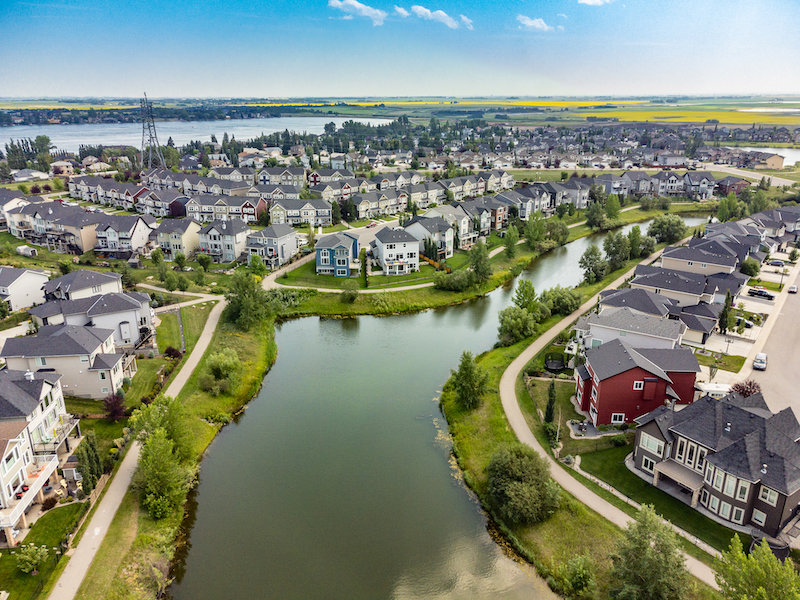
- Chestermere Lake completely transforms the lifestyle in Chestermere from a suburban life into a resort-style sanctuary. The residents of this town have recreational opportunities year-round! With a quick drive, they can enjoy the beautiful lake view, and partake in some summer boating, some wakeboarding, winter ice skating or fishing, and most importantly, they can visit the many beaches for swimming or relaxation.
The Downside
But as any boater knows, when too many people jump into the Chestermere Lake at once, massive waves are created. The very charm that draws thousands of new residents to The Pearl of the Prairies every year is starting to exhaust the city’s infrastructure. Behind these beautiful lakeside views, Chestermere is facing some serious struggles. A small town cannot transform from a quiet commuter town into a vibrant city overnight without hitting a few speed bumps on the way.
- Education Deficit: Like many of the other fast growing communities in Alberta, new schools struggle to build at a rate to keep up with the upcoming student population. This leads to incredibly crowded classrooms, or often children having to get bussed to other schools much further away.
- Heavy Traffic and Road Delays: since a large population of the residents remain commuters to Calgary, the major connecting routes (such as 17th Ave SE, Chestermere Boulevard, and Peigan Trail) face extremely heavy rush-hour congestion.
- Fast Changing Community Identity: As time goes on and the population grows, Chestermere and its residents continue to struggle to maintain their original ‘small town, lakeside charm’ as it battles with the reality of high-density urban planning to tackle the housing crisis they are anticipating.
- Infrastructure Budget Strain: The rapid resident increase has been putting pressure on roads, available utilities, and municipal services. This has forced the city to hit pause on several unstarted capital projects to reserve funds for projected expenses.
Data-Driven Growth: Capitalizing on Canada’s Rapidly Shifting Markets
For businesses, population growth exceeds demographic statistics, as it is the main indicator of future consumer demand. By combining population trends with demographic data, customer insights, as well as household spending patterns, organizations can better comprehend where new opportunities are emerging.
When a municipality, such as Chestermere experiences a population growth of nearly 15% in just one year, the demand for all major industries in that region shifts completely. Newcomers urgently require necessities, such as housing, food, healthcare, education, financial products, retail stores, recreational services, better transportation, and so on.
How Businesses Can Benefit from Population Growth
- For retailers, the rapid growth within these communities represents strong opportunities of establishing a presence prior to other competitors. Businesses can use location intelligence, retail analytics, and trade area analysis to identify high-growth communities. This helps them allocate resources more effectively. Whether it’s a financial institution determining site selection for a new branch, or a CPG brand analyzing regional shopping habits, localized demographic data removes the guesswork from market expansion.
- For real estate developers, population growth data can support site selection, market potential assessments, and long-term strategic planning for future developments.
- Healthcare providers, financial institutions, and telecommunication companies can use population growth data to identify emerging markets, anticipate demand, and make more informed business decisions.
Looking Beyond Chestermere
Chestermere has attracted our attention due to its remarkable growth rate over the past two years, but it is far from the only Alberta municipality experiencing this rapid growth. Across the province, several communities are benefiting from strong migration patterns, economic development, and increased demand as a whole. These trends highlight Alberta’s growing market potential while reinforcing the importance of demographic data when evaluating future growth opportunities. Other examples include:
- Airdrie
- Beaumont
- Canmore
- Leduc
- Cochrane
- Mackenzie County
Why Population Growth Data Matters
Understanding which communities are projected to grow, how quickly this expansion will occur, and the demographics moving into them provides businesses, governments, and investors with incredibly valuable insights. Population growth is not distributed evenly across Canada. Many areas are expanding at a rapid rate while others experience stagnant growth and overall population decline. Having the ability to identify these trends early on will give businesses a significant competitive advantage
The tale of Chestermere is ultimately a story about the future of Canada’s growth. As the country’s population continues to age, and natural population growth hinders, migration continues to be the primary driver of population growth. Communities that attract newcomers, create employment opportunities, support economic growth, and maintain a high quality of life are positioned for long-term, sustainable success.
For organizations seeking deeper business intelligence, population growth data provides valuable insight into where future business opportunities will emerge. By leveraging demographic intelligence, Canadian data, geodemographics, and advanced data analytics from companies like Manifold Data Mining Inc. and Polaris Intelligence, businesses are able to identify emerging markets, understand the fluctuating markets in which they operate, and will make more informed decisions about expansion opportunities, investments, and resource allocation as a whole.
Today’s fastest-growing communities are tomorrow’s most important consumer markets and should not be ignored. Understanding where growth is occurring is the very first step toward understanding where expansion opportunities lie.