Looking for the French version? Read Trouver les consommateurs francophones hors Québec.
Introduction
Every year on June 24th, the streets of Quebec light up with bonfires, music, and a sea of white and blue celebrating La Fête nationale du Québec. While this day is deeply rooted in Québécois identity and pride, it also serves as a beautiful reminder of the broader French-speaking community stretching across the nation.
French is one of Canada’s official languages. While Quebec is the beating heart of Francophone culture in North America, there are nearly a million French speakers who thrive completely outside of Quebec’s borders.
Based on data from Manifold Data Mining Inc., approximately 20.4% of Canadians report French as their first official language spoken in 2025 (a total of 8,633,029 people). Nearly a million Francophones reside outside of Quebec, creating culturally vibrant Francophone communities from coast to coast. B2C businesses often look to expand across Canada. For these companies, accessing accurate, granular consumer data on these regions is the key to identifying untapped market opportunities.
The Landscape of French Across the Provinces
French speakers outside of Quebec vary significantly from one another. They represent distinct historical lineages, regional accents, and deep community roots. When studying those who claim French as their first official language, numbers from Manifold Data Mining Inc. paint an incredible picture:
- New Brunswick: Approximately 29.7% of the population reports French as their first official language. New Brunswick holds the proud title of being Canada’s only officially bilingual province.
- Ontario: Though French speakers only make up 3.4% of Ontario’s total population of 16,602,830, they still form a community of 557,519 people. These residents are referred to as Franco-Ontarians and are deeply rooted in the eastern and northeastern parts of the province.
- Nova Scotia: Around 2.8% of the total population has claimed French as their first official language. This community represents the Acadian populations. They bravely rebuilt the Atlantic region following the historic expulsions of the 1700s.
- Manitoba: French speakers make up 2.7% and carry forward a rich heritage that is deeply intertwined with early Métis history and the Red River Settlement.
- Quebec: Often considered the heart of Francophone culture in Canada, 81.6% of Quebec’s residents speak French as their first official language (over 7,500,000 residents).
Vibrant Francophone Hubs
If you travel outside of Quebec, you won’t have to look far to find thriving French-speaking communities. Several of Canada’s key cities showcase a distinctly bilingual culture.
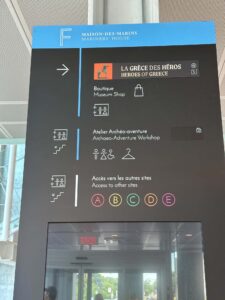
Below is a snapshot of bilingual civic infrastructure at the Maison-des-Marins (Mariners’ House) in Montreal, photographed by our CEO during a recent visit to Montreal when he spoke at the Vividata Vivo conference. This clean split between French and English text mirrors the dual-linguistic reality that B2C brands must master when mapping Canadian consumer markets.
Moncton, New Brunswick:
About 32.8% of the population is French-speaking. Moncton serves as an important cultural hub of Acadian culture, where the local Chiac dialect blends French and English structures. French-language media outlets and Université de Moncton help shape this community.
Ottawa, Ontario:
As the capital city of Canada, Ottawa features a substantial Francophone population of nearly 14%. Federal bilingualism policies help strengthen Ottawa’s role as a major hub for French-language institutions, healthcare, and secondary education.
Sudbury, Ontario:
Deep in Northern Ontario, nearly 21.8% of Sudbury’s residents speak French. This community grew from early agricultural and industrial settlements. Sudbury is still vibrant today. The city maintains dedicated school boards, cultural centers, and institutions such as Collège Boréal.
Saint Boniface (Winnipeg, Manitoba):
Boasting local pocket densities of up to 99.3% French speakers in historic tracts, this historic neighbourhood in Winnipeg is flourishing with cathedrals and serves as the cultural heart of Franco-Manitobans. Walking through these beautiful streets, you’ll find a community proud of their unique history, French-language businesses, and historic Métis roots.
Edmundston, New Brunswick:
Located near the borders of Maine and Quebec, a staggering 93.5% of the population identifies French as their first official language. As a result, Edmundston remains a vibrant center of Acadian and Madawaska culture.
For businesses, these regional differences matter. A Francophone consumer in Edmundston, Moncton, Ottawa, or Sudbury may share a language, but their local culture, media habits, and purchasing behaviours can look very different.
Living This Bilingual Reality
How do the lives of Francophones living outside of Quebec differ from those living inside? The differences mostly come down to navigating daily activities as a linguistic minority:
- Cultural Identity: Quebec culture is protected by provincial language laws and represents a demographic majority. However, Francophones in other provinces constantly balance their French heritage with a dominant Anglophone environment. This has created a resilient, deeply proud bicultural identity.
- Daily Language Use: In Quebec, French is the primary language of daily life, commerce, and media. Outside of Quebec, on the other hand, Francophones must code-switch every single day. They usually speak English in professional and public spaces, while maintaining French within community organizations and at home.
- Education and Support: Thanks to the Canadian Charter of Rights and Freedoms, all Francophones living outside of Quebec have access to an independent network of French-language school boards and French immersion programs. However, the level of provincial government support varies quite a bit depending on each province (outside of New Brunswick’s official provincial bilingualism).
The bilingual reality also shapes consumer behavior. When analyzing regional household spending data, businesses often find distinct purchasing patterns in these communities, from local media consumption to specific retail preferences.
Celebrating a Shared Mosaic
Francophone communities outside Quebec represent an important part of Canada’s linguistic and cultural landscape. While they share a first official language and common ancestry with Quebec, their life experiences are uniquely shaped by their surroundings. On this Fête nationale, as we watch the bonfires burn and the flags fly, we celebrate the incredibly resilient French language thriving across all of Canada.
Connecting the Dots for Canadian Businesses
For B2C organizations operating across Canada, understanding these unique demographic clusters is a major market opportunity. Francophones outside of Quebec represent tight-knit communities with strong regional identities. However, successfully engaging with them requires more than a generic marketing campaign. Your business must use precise, location-based intelligence.
By analyzing local market outliers, brands gain the ability to tailor their localized product offerings and regional messaging to resonate with these distinct communities.

Montreal’s famous, complex parking sign matrix (Photographed by our CEO). For B2C brands, trying to navigate fragmented regional demographics without clean data can feel exactly like trying to figure out where to legally park on a Tuesday afternoon.
Without a centralized platform, businesses often get stuck staring at raw census sheets trying to decipher where the true opportunities lie. By leveraging targeted, location-based intelligence, brands can cut through this visual and mathematical noise to find exactly where their audience is clustered.
Maximize your Audience Reach
Ready to unlock a deeper understanding of Canada’s diverse consumer market? Don’t rely solely on static demographic snapshots that may miss evolving consumer behaviours.
Whether you are optimizing omnichannel digital campaigns using mobile ad IDs (MAIDs), such as GAID and IDFA, or mapping out your retail locations based on high-value demographic traits, precision matters substantially.
Discover how Polaris Intelligence can transform your consumer insights. Contact our team today to explore our robust household spending data and learn how our custom consumer segments can empower your next growth initiative.