
Canada is a country of two official languages, English and French. While English is predominant across most of the country, French-speaking communities thrive in certain areas, notably in New Brunswick and Quebec. The movement of minority language speakers, especially skilled youth, can significantly impact these communities, both culturally and economically. This blog explores the effects of migration among minority language speakers, focusing on New Brunswick as a case study.
New Brunswick: A Case of Skilled Youth Migration
New Brunswick is Canada’s only officially bilingual province, with approximately one-third of its residents identifying French as their first official language. Despite this, the province faces significant challenges in retaining its young, skilled French-speaking population.
Key Findings:
- Net Loss of Young Skilled French Speakers: Between 2010 and 2017, New Brunswick experienced a net loss of 19% of its young skilled French-speaking population. This indicates that one in five young skilled French speakers left the province two years after obtaining their postsecondary education.
- Higher Loss Among Degree Holders: The net loss was more pronounced among degree holders, with 26% of this group leaving the province, compared to 14% of those with certificates or diplomas.
- Discipline-Related Losses: New Brunswick was more likely to lose young skilled French speakers from generally lower-paying disciplines (23%) than from higher-paying disciplines (18%).
Economic Implications
The migration of young skilled French speakers has significant economic implications for New Brunswick. Postsecondary education is partially funded by the provinces, so the departure of graduates represents a loss of investment. Additionally, the loss of skilled workers can weaken local economies, especially in smaller communities where these individuals drive economic activity and cultural vibrancy.
Why People are Leaving New Brunswick
Several factors contribute to the outmigration of skilled young people from New Brunswick:
- Economic Opportunities: New Brunswick’s economy, while diverse, often cannot match the higher salaries and broader job opportunities available in other provinces. Young professionals, particularly those with degrees, are attracted to regions with robust job markets and better career prospects.
- Educational Aspirations: Many young people leave New Brunswick to pursue higher education or specialized training programs that may not be available locally. Upon graduation, they often find it more advantageous to remain in their new locations where job prospects are more promising.
- Urbanization: There is a general trend towards urbanization, with young people preferring to live in larger cities that offer more amenities, social opportunities, and lifestyle benefits. New Brunswick’s smaller urban centers struggle to compete with the allure of metropolitan areas like Toronto, Montreal, or Vancouver.
- Perception of Better Living Standards: Other provinces are perceived to have better healthcare, education, infrastructure, and overall living standards, which can entice young families and individuals to relocate.
- Linguistic and Cultural Integration: For some, particularly those who are bilingual or more comfortable in English, the cultural and linguistic environment of other provinces can be more appealing. This is particularly true for those who may feel limited by the Francophone community’s size and influence in New Brunswick.

Retention and Recruitment Strategies
To counteract these losses, provinces need to focus on both retaining their skilled youth and attracting talent from other regions. Here are some strategies that could help:
- Encouraging Local Education: Data shows that two-thirds of young skilled French speakers who left Ontario obtained their postsecondary education in Ontario before leaving. Encouraging youth to pursue higher education locally could help with retention.
- Attracting Skilled Workers: Alberta, for instance, managed to achieve a net skill gain of 70% by attracting a large number of young skilled French speakers. Developing attractive job opportunities and promoting the province’s benefits could help New Brunswick and other provinces attract similar talent.
- Focusing on Higher-Paying Disciplines: Ontario successfully attracted young skilled individuals from higher-paying disciplines, resulting in a net gain of 19%. Emphasizing fields like STEM, business, health, and law could enhance recruitment efforts.
Cultural and Community Impact
The departure of minority language speakers not only impacts the economy but also affects the cultural fabric of communities. Retaining French speakers in New Brunswick is vital for maintaining its bilingual identity and cultural heritage. Community initiatives that promote cultural engagement and support for minority language speakers can play a crucial role in strengthening community bonds.
Migration Patterns and Fiscal Implications
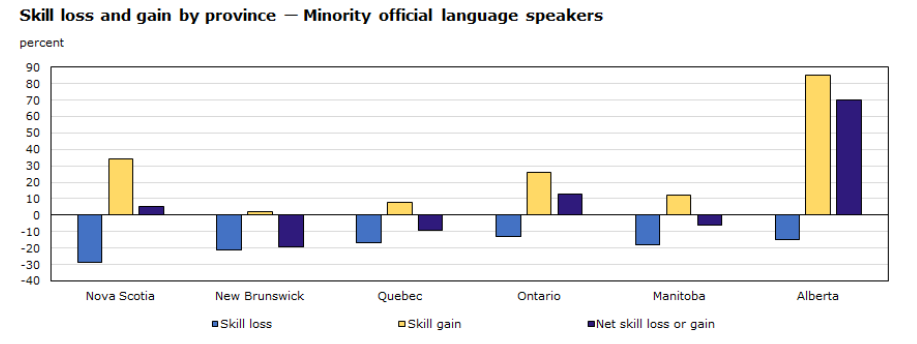
Migration Trends Across Provinces
- Ontario: Ontario registered a modest net gain of 13% among young skilled minority official language speakers (MOLSs) while experiencing a slight loss of 3% among non-MOLSs. This suggests that Ontario is more effective at retaining and attracting young skilled French speakers than its counterparts.
- Quebec: Quebec saw a net loss of 9% of its young skilled English-speaking population. Despite its economic strength and cultural vibrancy, the province struggles to retain young skilled Anglophones.
- Alberta: Alberta emerged as the top performer, with a net skill gain of 70% among young skilled French speakers. This success is attributed to its robust economic opportunities and aggressive recruitment strategies.
- Nova Scotia: Nova Scotia achieved a net skill gain of 5% among young skilled MOLSs, though it faced a net skill loss of 9% among non-MOLSs.
- Manitoba: Manitoba reported a net loss of 6% of its young skilled French-speaking population, reflecting broader challenges in retaining skilled workers.
Fiscal Impact of Migration
The fiscal implications of migration are significant. Provinces invest in postsecondary education, and the migration of graduates can represent a loss of this investment. The data highlights the fiscal impact by showing the percentage of leavers and entrants who completed postsecondary education before leaving or entering their respective provinces.
- Ontario: Two-thirds (67%) of leavers obtained their postsecondary education in Ontario before leaving, compared to 41% of entrants who did so before arriving. This indicates that Ontario is losing a considerable amount of its locally educated talent.
- New Brunswick: For New Brunswick, 42% of leavers obtained their postsecondary education locally before leaving, while only 35% of entrants did so before arriving. This suggests a net loss of locally educated talent.
Policy Recommendations
To address these challenges, targeted policies and programs are essential. Here are some recommendations:
- Enhancing Local Job Opportunities: Creating more high-paying job opportunities in minority language communities can help retain skilled workers. This includes investing in key industries and promoting entrepreneurship.
- Educational Incentives: Providing incentives for students to pursue higher education within their home provinces can improve retention. Scholarships, grants, and targeted programs can encourage youth to stay local.
- Cultural Engagement: Strengthening cultural initiatives that celebrate and support minority language speakers can enhance community ties and identity. This includes supporting cultural festivals, language programs, and community centers.
- Attractive Living Conditions: Improving the quality of life in minority language communities through better infrastructure, healthcare, and recreational facilities can make these areas more attractive to young professionals.
- Recruitment Campaigns: Active recruitment campaigns targeting skilled workers from other regions and abroad can help offset losses. Highlighting the unique cultural and economic benefits of minority language communities can attract new talent.
Conclusion
The migration patterns of minority language speakers underscore the need for strategic efforts to retain and attract skilled workers. New Brunswick’s significant net loss of young skilled French speakers highlights the broader challenges faced by minority language communities across Canada. By implementing targeted policies and programs, provinces can strengthen their cultural identity, enhance economic vitality, and create vibrant, sustainable communities that celebrate and preserve their linguistic heritage.
This analysis is based on data from Statistics Canada, examining the mobility patterns of young skilled minority official language speakers across six provinces: New Brunswick, Quebec, Ontario, Manitoba, Nova Scotia, and Alberta. The findings underscore the importance of strategic efforts to retain and attract skilled workers to ensure the continued growth and prosperity of minority language communities in Canada.
Understanding these migration trends and their implications is crucial for policymakers, educators, and community leaders. By fostering environments that support and celebrate minority language speakers, provinces can build stronger, more resilient communities that thrive both economically and culturally.